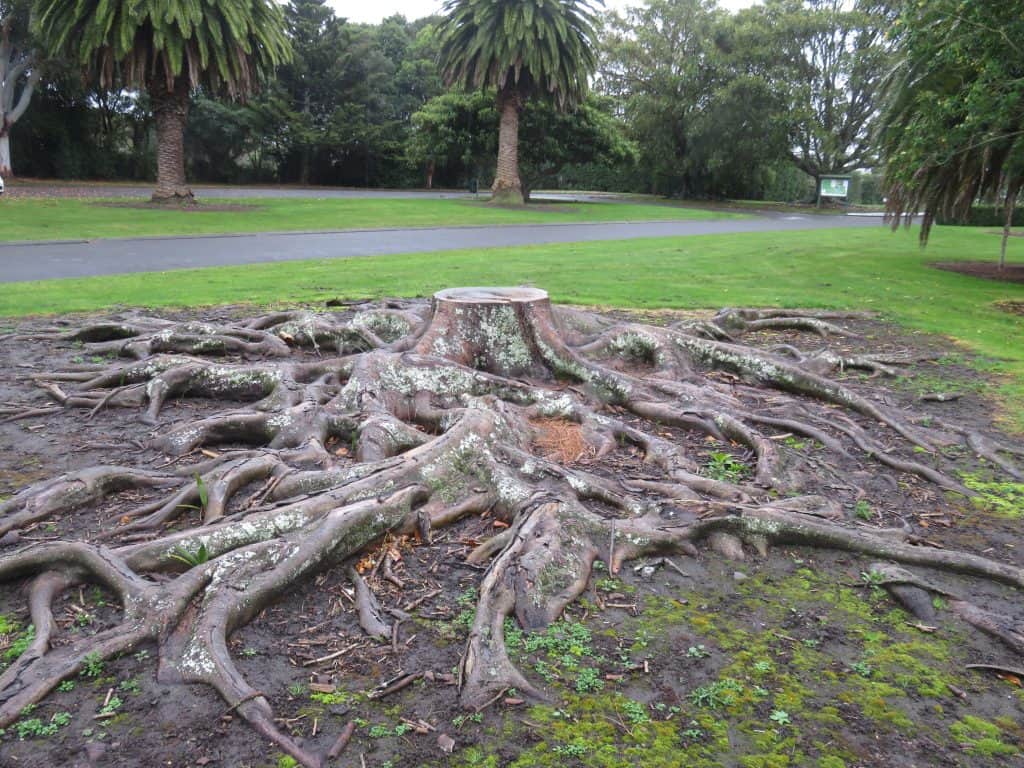
There has been interest in the stump on the main drive to the right just before you reach the main carpark on the Top Flat. This was a Moreton Bay fig, which blew to pieces in a storm to become a danger, and therefore had to be removed by the District Council. However, these trees develop an extensive root system on top of the ground. Since it was impractical to remove this, it has been left until it decays enough to be removed easily. The root system is needed to help support the tree, which can grow enormous.
A number of Moreton Bay figs are still growing in the Gardens, and add to the tropical theme around the Conservatories. There is a large tree in Pakaitore/Moutoa Gardens, and even bigger ones in Russell (Bay of Islands) and Albert Park, Auckland, among others. One in Devonport has many aerial roots from the branches rooted into the ground. One of the biggest Moreton Bay figs in the world, at Pahi on the Kaipara Harbour, has a spread of over 50 metres.
Until a couple of decades ago, Moreton Bay figs only produced sterile flowers in New Zealand. However, eventually a specialist tiny wasp arrived in the country, enabling the development of fruit and seeds. These fruits, which are quite hard and not palatable to people, are nevertheless favoured by kereru, and Moreton Bay fig seedlings now appear in profusion around the Gardens. The most popular host there is the Canary Island phoenix palm (there are a number in the same vicinity as the stump).
This is potentially a problem. The Moreton Bay fig is a “strangler fig”. It can germinate high in the branches of a tree, the roots then creeping down to the ground, where they eventually suppress and kill the host tree. This is the form of propagation of the northern rata (such as Ratanui at Bushy Park), and the fear is that it will allow the Moreton Bay fig to get spread into native forest, where it would be difficult to locate and destroy.