

Winter is a great time to visit the Millennium Hill to view the Aloe collection. Planted in 2007, thanks to a generous donation from Heather Giltrap, this collection has grown over the years and now boasts a wide selection of mature plants including an avenue of the Aloe bainesii (or the tree aloe). These slow-growing large African succulents are in bud now with a delicate apricot pink flower that provides a useful boost of winter nectar to Tui.
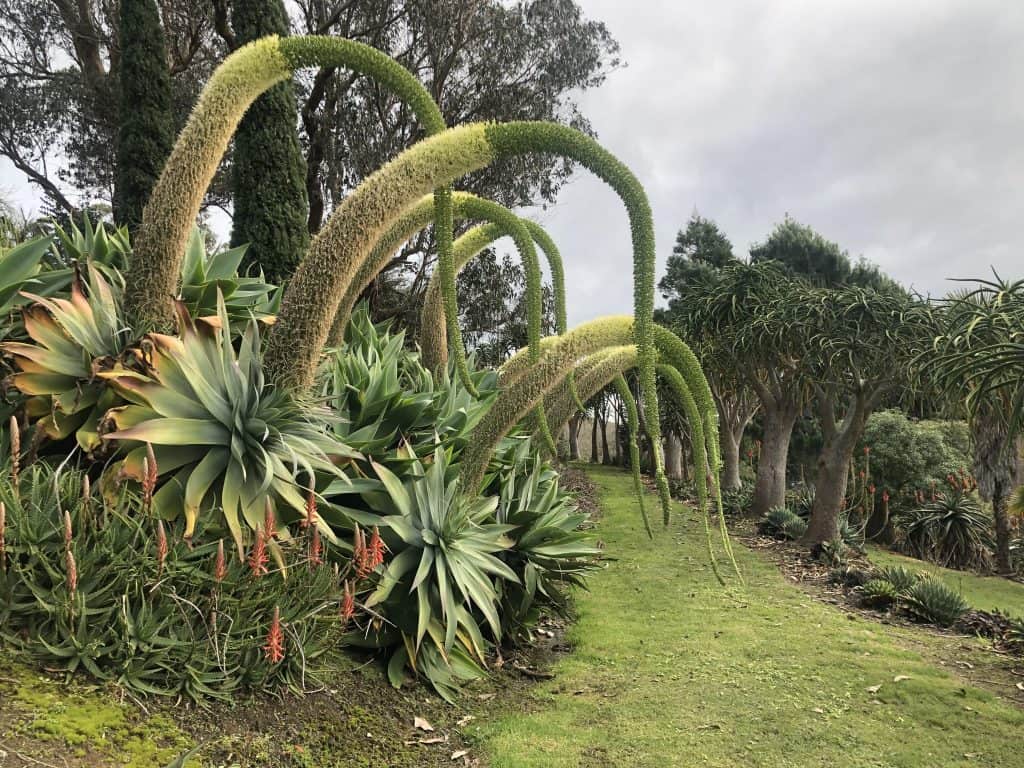
Beside the avenue of tree aloes is a weird display of what looks like giant yellow pythons, but relax, these are the flowers of Agave attenuate or the foxtail agave. This large, rosette forming grey blue Agave native of central Mexico, sends up a flower stalk that can reach 3m in length. Given the length and weight of the stalk they tend to bend in a graceful arch, each stalk is covered in a mass of
lemon yellow flowers which can form seed pods and a host of new pups that can be grown on to form new plants. While the rosette dies after flowering, as these plants tend to grow in a clump, the other rosettes or suckers) will grow to cover the gap or in the clump. Unlike many of the other Agaves, Agave attenuata doesn’t have sharp spines and as it grows from pups or suckers it is often seen in domestic gardens where its rhizomatous root structure makes it a useful (if somewhat large) plant to grow on banks, as in the Bason’s Millennium Hill.
Other Agaves grown nearby include the spiky versions such as Agave colorata, Agave parryi and Agave geminiflora. Most of the Agaves are native to various regions of Mexico.

Also in this area and very showy at this time of year are the winter flowering Aloes including Aloe africana (African aloe) which can grow into a tree-like plant, and its close but even more spiky version Aloe ferox, (the fierce or woody aloe). Less spiky and with a more showy flower is Aloe rupestris (the bottle brush aloe) and Aloe thraskill (the candelabra or dune aloe).
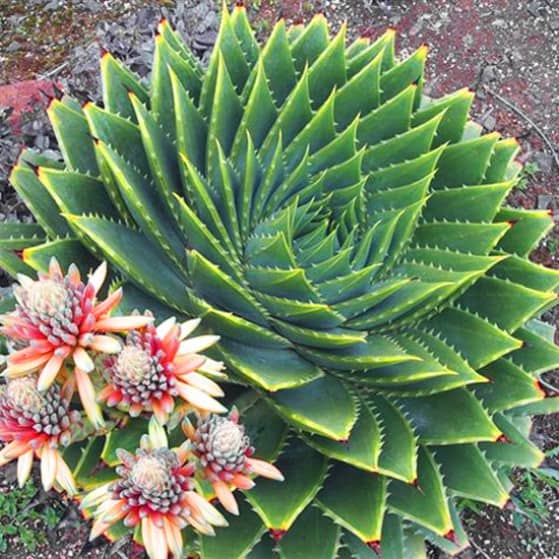
Not as tall, but equally as showy is Aloe polyphylla (spiral aloe) which grows as a large barrel like plant in a complex spiral pattern.
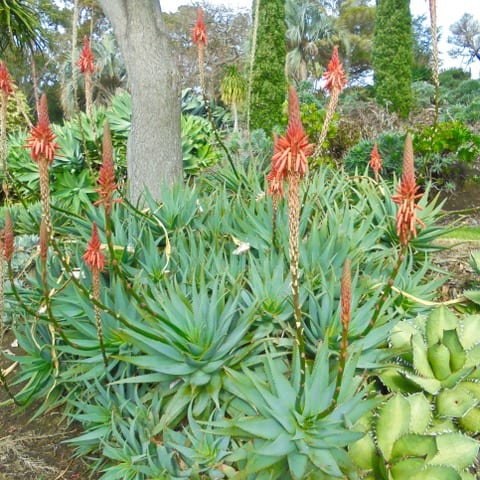

While some Aloes tend to be more upright and singular growing plants, other aloes like to grow in massive clumps such as Aloe arborescens (torch aloe) and Aloe spinosissima (spider aloe). Most of the Aloes are native to parts of Africa.
So, if you think winter can be a bit drab and are looking for a shot of colour, come out and take a wander down Millennium Hill to check out these showy succulents… no need to worry about snakes.